DTV Visa Timeline for Self-Applicants: When to Book Flights, Hotel and Submit Your Thailand DTV Application
Applying for the Thailand DTV Visa by yourself? Learn when to prepare documents, book flights, reserve a hotel and submit your application without avoidable timing mistakes.
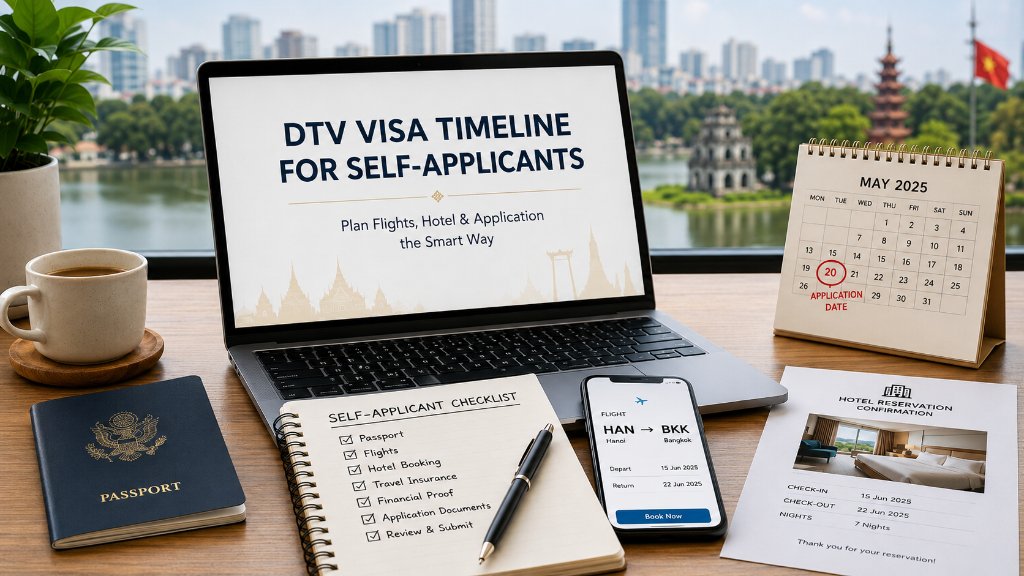
Many Thailand DTV Visa applicants do not run into problems because they are not eligible. They run into problems because they plan the timeline incorrectly.
This is especially true for self-applicants. When you apply by yourself, you need to understand the document requirements, choose the right embassy, prepare the correct proof, book flights and hotel at the right time, and avoid submitting too close to your travel date.
The DTV Visa is one of the best long-stay visa options for remote workers, digital nomads, freelancers, business owners, Muay Thai students, medical treatment visitors and other Soft Power applicants. But if you are handling the application yourself, timing matters.
This guide explains how self-applicants should plan the DTV Visa timeline, when to book flights, how long to book a hotel for, and when to submit the application.
If you work with Thai DTV Visa, the process can often move faster because we already know how to structure the case, prepare the document package, choose the right route and avoid common mistakes. However, embassy processing times and final decisions are always controlled by the embassy, not by us.
Why Your DTV Visa Timeline Matters
The DTV is a long-term visa, but the application itself is still embassy-based. That means the decision is made by a Royal Thai Embassy or Consulate, not by an online system that works the same way everywhere.
Each embassy may have its own workflow, review speed and document expectations. One embassy may process a clean application quickly, while another may take longer or ask for additional documents before making a decision.
A weak timeline can create stress even if the applicant is otherwise eligible. Booking the wrong dates can lead to extra hotel costs, missed flights, or unnecessary pressure to submit before the document package is actually ready.
The goal of a good DTV visa timeline is not only to get the visa. It is to avoid avoidable complications — extra nights in a hotel, changed flights, or a rushed submission that creates more problems than it solves.
Why Self-Applicants Usually Need More Time
When you apply for the DTV Visa by yourself, you are not only filling in an application form. You are also trying to understand the full process at the same time.
Self-applicants usually need more time because they must:
- Choose the correct DTV category
- Understand whether Remote Work, business owner, freelancer or Soft Power is the best route
- Check which embassy is suitable for their nationality and current location
- Prepare financial proof correctly
- Collect remote work, business or Soft Power documents
- Make sure hotel and travel dates make sense
- Avoid submitting unclear or inconsistent documents
- Respond to additional embassy questions if needed
This is why we recommend self-applicants to start earlier. A person who has never handled a DTV application before naturally needs more time than a team that works with these cases regularly.
At Thai DTV Visa, we can often prepare and move much faster when the client provides information quickly and the case is suitable. But for self-applicants, extra preparation time is the safer approach.
The Biggest Timing Mistake: Booking Everything Too Early
Many applicants want to book flights and hotels immediately. This feels organized and responsible. In reality, it can be risky.
Visa decisions are not guaranteed by a specific date. The embassy may request additional documents, which adds time. Embassy holidays, weekends, local closures and review queues can all affect timing. A decision that "usually" takes a week can take longer in a particular case.
Return flights should usually not be locked too early unless the ticket is flexible or refundable. A fixed, non-refundable return ticket bought before the visa decision can become a problem if the decision is delayed.
For DTV planning, flexibility is often more valuable than saving a small amount on a ticket. A slightly more expensive but changeable ticket can save far more money and stress than a cheap non-refundable one.
When Should You Start Preparing for the DTV Visa?
For self-applicants, we usually recommend starting 3–6 weeks before the planned travel date. This gives enough time to understand the process, collect documents, check embassy options, prepare financial proof and avoid rushed mistakes.
If your documents are already strong and your case is simple, 2–3 weeks may be enough. But this is still more comfortable if you already know what you are doing.
If you use professional help, the preparation stage can often be much faster, especially when the case is clear and the applicant responds quickly. However, the final embassy processing time can never be guaranteed.
More time is still needed if you are applying as a business owner, freelancer, or remote worker with complex documents, as a family where each member needs their own documents, or if documents need translation, notarization, company documents, bank statements, contracts or supporting letters. Soft Power applications also need extra time, because the school, Muay Thai gym, medical provider or activity provider must issue proper documents.
If you are already in Thailand and need to apply from a nearby country, timing becomes even more important. You also need to plan your exit from Thailand, your hotel stay abroad, and your return route — all of which depend on when the decision is expected.
When to Prepare Your Documents
The document package should be prepared before travel dates are finalized where possible. Preparing documents first, then booking travel, gives you a cleaner timeline and reduces the risk of rushing.
Required and supporting documents often include:
- Passport copy
- Recent photo
- Proof of current location
- Financial evidence
- Remote work, business, freelance or employment documents
- Soft Power confirmation documents if applying under Muay Thai, medical treatment or another activity
- Hotel or accommodation booking
- Flight or travel plan where required
- Additional explanation letters where useful
A clean document package reduces the chance of delays. Unclear screenshots, missing names, wrong dates, weak financial proof, inconsistent information or poorly prepared supporting documents can all slow the process.
For a full breakdown of what to prepare, see our DTV Visa documents checklist.
When to Book Your Flight to the Application Country
We use Hanoi and Vietnam as the main example here, but the same logic applies to other embassies. The recommended approach is:
- First, check whether the embassy and country are suitable for your passport and case.
- Then prepare the core documents.
- Then book the flight to the application country.
- Avoid arriving on a weekend or public holiday if you want to submit quickly.
- Arriving Friday evening or Saturday often means the first realistic working day is Monday.
- If arriving in Hanoi, many clients plan to arrive over the weekend and submit on Monday morning if documents are ready.
- Always check embassy working days and holidays before finalizing dates.
For nearby-country applications, the flight should not be viewed as a normal holiday booking only. It is part of the visa strategy. The arrival day, the embassy working days, and the expected review period all need to fit together.
Read more about this route in our DTV Visa Hanoi and DTV Visa Vietnam guides.
How Long Should You Book a Hotel For?
For Hanoi-style applications, we usually recommend booking the hotel for around one week at first.
In many cases, a decision may come within a week, but this is not guaranteed. Some cases may be faster. Some cases can take longer if there are additional questions or document requests.
A hotel booking from your arrival date through the expected review period gives a cleaner timeline. The hotel confirmation should show:
- the applicant's name clearly
- the dates of stay
- the accommodation details
- preferably be in English
If you are applying as a family, the booking should ideally show the relevant family members or match the travel plan clearly.
Do not book the cheapest non-refundable hotel only to save money if your dates may change. A flexible booking can be more valuable during a visa process than a small saving on the room rate.
Should You Book the Return Flight Before the Visa Decision?
In many cases, we recommend waiting with the return flight until the visa decision is received, unless the ticket is flexible, changeable or refundable.
The visa decision date is never fully guaranteed. Buying a fixed return ticket too early can create stress if the decision is delayed. If the decision is delayed, the applicant may need to change the ticket. If the visa is approved earlier, the applicant can return earlier if desired.
Flexibility is important. However, if a certain embassy requires proof of onward travel or a travel itinerary, use a realistic plan that matches the application strategy rather than a random booking that does not fit the timeline.
The right approach depends on the embassy, your nationality, your document strength and your current situation.
When Should You Submit the DTV Visa Application?
Submit only when the document package is complete and consistent. Do not rush submission with missing or weak documents.
A fast but weak submission can cause more delays than a well-prepared submission one day later. The embassy reviews the file you submit — not the file you intend to complete later.
For Hanoi and Vietnam, Monday submission is often a practical target when the applicant arrives during the weekend. If arrival is on Friday or Saturday, prepare everything before arrival so the application can be submitted on the next working day.
Avoid submitting right before embassy holidays. Avoid planning departure too close to the expected decision date. Both create unnecessary pressure on a process that is already embassy-dependent.
Example Timeline for a DTV Visa Application Through Hanoi
Here is a practical example of how a DTV visa timeline can look when applying through Hanoi. This is only an example, not a guaranteed schedule.
Day -14 to Day -7
Initial case review, category selection, document request, financial proof check, and remote work or Soft Power document preparation.
Day -7 to Day -3
Finalize the application package, confirm the travel plan, book the hotel, and check embassy working days and holidays.
Day 0
Arrive in Hanoi.
Day 1
Submit the application if all documents are ready and it is a working day.
Day 2–5
Wait for review. Be ready to answer additional questions quickly if the embassy contacts you.
Day 5–7
In many cases, a decision may be received around this period, but timing is not guaranteed.
After approval
Complete any required steps if applicable, receive the visa confirmation, and book the return flight to Thailand.
Important
This is only an example timeline, not a guaranteed schedule. Real processing time depends on the embassy, document quality, and whether additional documents are requested.
Timeline Differences: Remote Work vs Soft Power DTV
The DTV visa timeline can look different depending on your category.
Remote Work
- More focus on employment, company ownership, freelance activity, portfolio, income source and financial proof.
- Business owners may need extra preparation because company documents and role explanation must be clear.
- Freelancers may need portfolio, client evidence, contracts or invoices depending on the case.
Soft Power
- More focus on the approved activity itself.
- Muay Thai, medical treatment, cooking classes or other eligible activities require confirmation from the provider.
- The provider's document quality matters — a weak confirmation letter can slow the whole timeline.
- Course dates and travel dates should make sense together.
Read more in our DTV Remote Work category and DTV Soft Power category guides.
Why Embassy Holidays and Weekends Matter
Embassies do not process applications every day. Weekends do not usually count as working days. Public holidays in Thailand and in the application country can both affect processing.
If you arrive just before holidays, you may lose several days with no progress on your application. Always check closures before booking flights and hotel.
Good planning around embassy holidays can save both money and stress. A few days of awareness can prevent a week of unnecessary hotel nights.
What Can Delay a DTV Visa Application?
Common causes of delay include:
- Missing documents
- Unclear scans or screenshots
- Bank statement that does not show required details
- Name mismatch between passport, hotel, flight or documents
- Weak explanation of remote work activity
- Soft Power provider documents that are incomplete
- Documents that are not in English or Thai where required
- Embassy requests additional documents
- Public holidays or local closures
- Applicant submits too close to travel date
- Overstay history or complicated immigration background
A delay does not always mean rejection. Often it simply means the embassy needs clearer proof. The right response is to provide what is asked, clearly and quickly — not to panic.
Our Recommended DTV Visa Planning Rules
- Do not book non-refundable flights too early.
- Prepare documents before leaving Thailand or your current country.
- Keep your hotel booking realistic and flexible.
- Do not assume the visa will be approved on a specific date.
- Avoid embassy holidays and weekends.
- Make sure all documents match your story.
- Keep your phone and email available for additional questions.
- Work with someone who understands the embassy-specific process.
- Keep a backup budget for extra hotel nights.
- Book return travel only when it makes sense.
Can Thai DTV Visa Help With the Timeline?
Thai DTV Visa helps clients build a realistic DTV visa timeline. We can help you:
- Choose the right application route
- Review eligibility
- Decide between Remote Work and Soft Power category
- Prepare the document package
- Plan flight and hotel timing
- Check if Hanoi, Vietnam or another embassy is suitable
- Reduce the risk of avoidable document mistakes
- Support you during the process
We cannot guarantee an exact decision date because that depends on the embassy. But we can help build a realistic plan and avoid common timing mistakes that create unnecessary stress and cost.
See our DTV Visa cost and DTV Visa requirements pages for more context on the full process.
Need Help Planning Your Thailand DTV Visa Timeline?
If you are planning to apply for the Thailand DTV Visa and are not sure when to book flights, hotel or submit the application, we can help you build a clear timeline based on your situation.
Whether you apply through Hanoi, another nearby country, or from your home country, the right preparation can make the process smoother, less stressful and more predictable.
This guide is written mainly for people who are planning to apply for the Thailand DTV Visa by themselves. If you are doing everything alone, it is better to give yourself more time than to rush the process and create avoidable problems.
With Thai DTV Visa, the preparation can often be much quicker because we already know what to check, what documents are usually needed, which routes are practical, and where timing mistakes usually happen. Still, no one can guarantee an exact embassy decision date, so the goal is always to build a realistic and safe plan.
Want to Avoid the Self-Applicant Guesswork?
If you are applying by yourself, this timeline will help you avoid the most common planning mistakes. But if your case is urgent, complicated, or you simply want the process handled properly from the beginning, Thai DTV Visa can help you plan the right route, prepare the documents and move faster where possible.
We usually respond within 24 hours, and in most cases much faster.
Important note: Final visa approval and all decisions regarding DTV visa applications are made solely by the Royal Thai Embassy or Consulate reviewing your application. Thai DTV Visa provides document preparation and application support only. We do not guarantee visa approval or any specific processing time.
Frequently Asked Questions
How early should I start preparing for the Thailand DTV Visa?+−
Should I book my flight before applying for the DTV Visa?+−
How long should I book a hotel for when applying in Hanoi?+−
Can I book my return flight before the visa is approved?+−
How long does a DTV Visa application take?+−
What can delay my DTV Visa application?+−
Is Hanoi a good place to apply for the Thailand DTV Visa?+−
Can Thai DTV Visa help me plan flights and hotel?+−
Explore DTV Visa Resources
Want to Avoid the Self-Applicant Guesswork?
If you are applying by yourself, this timeline will help you avoid the most common planning mistakes. But if your case is urgent, complicated, or you simply want the process handled properly from the beginning, Thai DTV Visa can help you plan the right route, prepare the documents and move faster where possible.